



OLED vs QLED vs Mini LED: Which TV Display Is Best for You?

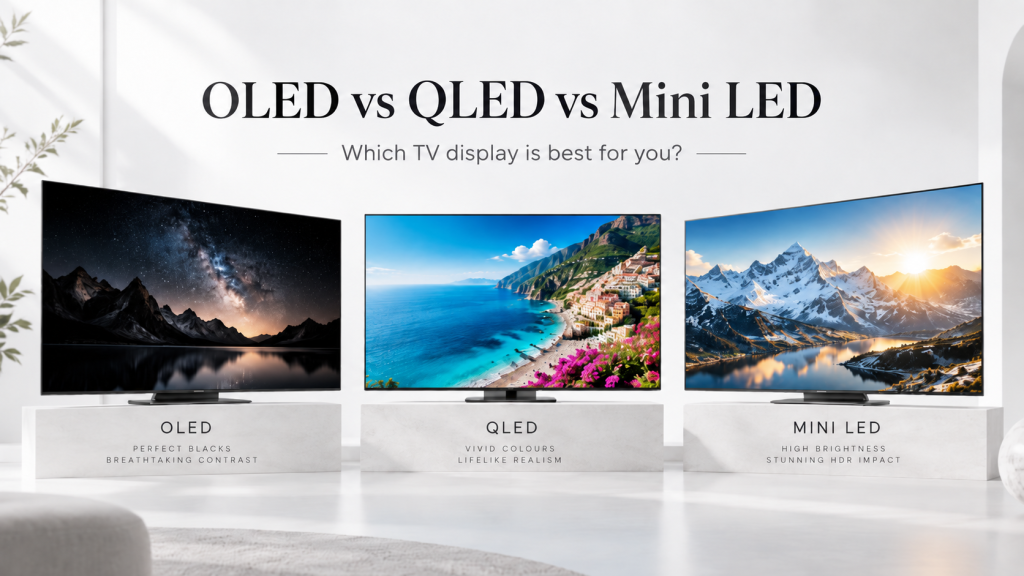
OLED is generally the best choice for deep blacks, cinematic contrast and fast gaming response. Mini LED is often better for bright rooms, sports and impactful HDR, while QLED offers the widest selection of screen sizes and price points.
However, the display label alone does not determine whether a TV is good. A premium QLED with effective local dimming may outperform an entry-level Mini LED model, while a newer OLED may be bright enough for a living room that would have challenged older OLED televisions. The right choice depends on your room lighting, viewing habits, gaming needs and budget. This OLED vs QLED vs Mini LED guide explains the key differences and helps you choose the best TV for your home.
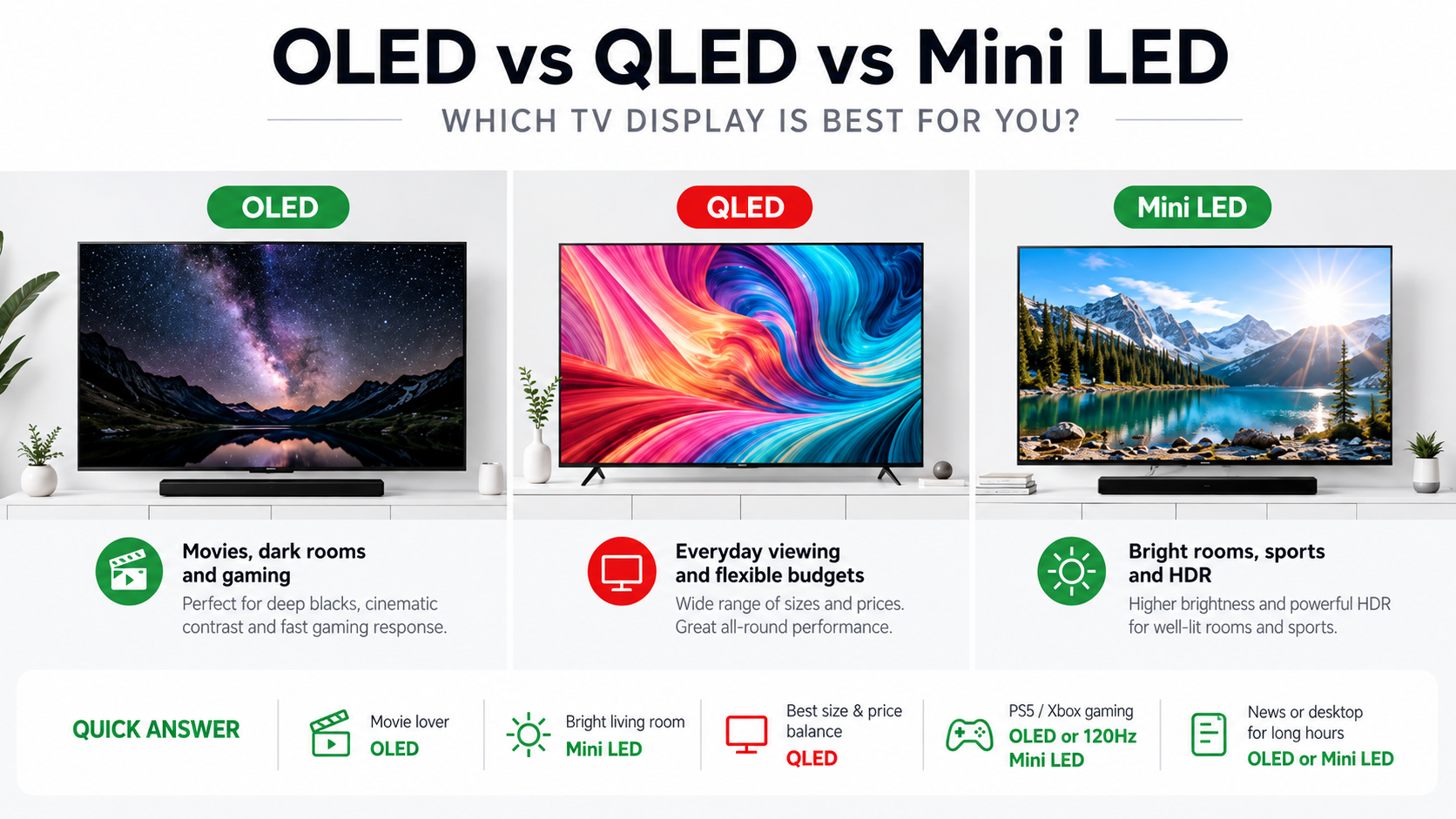
Quick Answer: Which TV Should You Buy Based on Your Needs?
- Movie lover: OLED
- Bright family living room: Mini LED
- Best balance of size and price: QLED
- PS5 or Xbox gaming: OLED or 120Hz Mini LED
- News or desktop displayed for long hours: QLED or Mini LED
That is the quick answer, but the best choice can change once room lighting, screen size, gaming features and budget come into play. Read on for a closer look at how OLED, QLED and Mini LED compare in real-world use.
OLED vs QLED vs Mini LED: Simple Comparison
| Consideration | OLED | QLED | Mini LED |
|---|---|---|---|
| Best for | Movies, gaming and watching from different angles | Everyday TV viewing and buyers with different budgets | Bright rooms, sports and HDR content |
| Picture in dark scenes | Excellent. Blacks look deeper and more realistic | Good, but dark scenes may look slightly grey on cheaper models | Very good, although a slight glow may appear around bright objects |
| Picture in a bright room | Depends on the model | Usually good | Usually the best |
| Colours | Natural and rich | Bright and colourful | Bright, colourful and impactful |
| Watching sports | Smooth motion and clear movement | Depends on the model | Great for daytime sports and bright rooms |
| Gaming | Excellent response and deep contrast | Good for most gamers | Great for bright HDR gaming |
| Watching from the side | Picture usually stays clear | Picture quality may reduce from the side | Depends on the model |
| Burn-in risk | Small risk if the same image stays on screen for many hours repeatedly | No OLED-style burn-in | No OLED-style burn-in |
| Price range | Usually more expensive | Offers the widest range of prices | Usually mid-range to premium |
| Simple verdict | Choose this for the best movie and gaming experience | Choose this for flexibility and better budget options | Choose this for brightness, sports and daytime viewing |
How Does OLED Work?
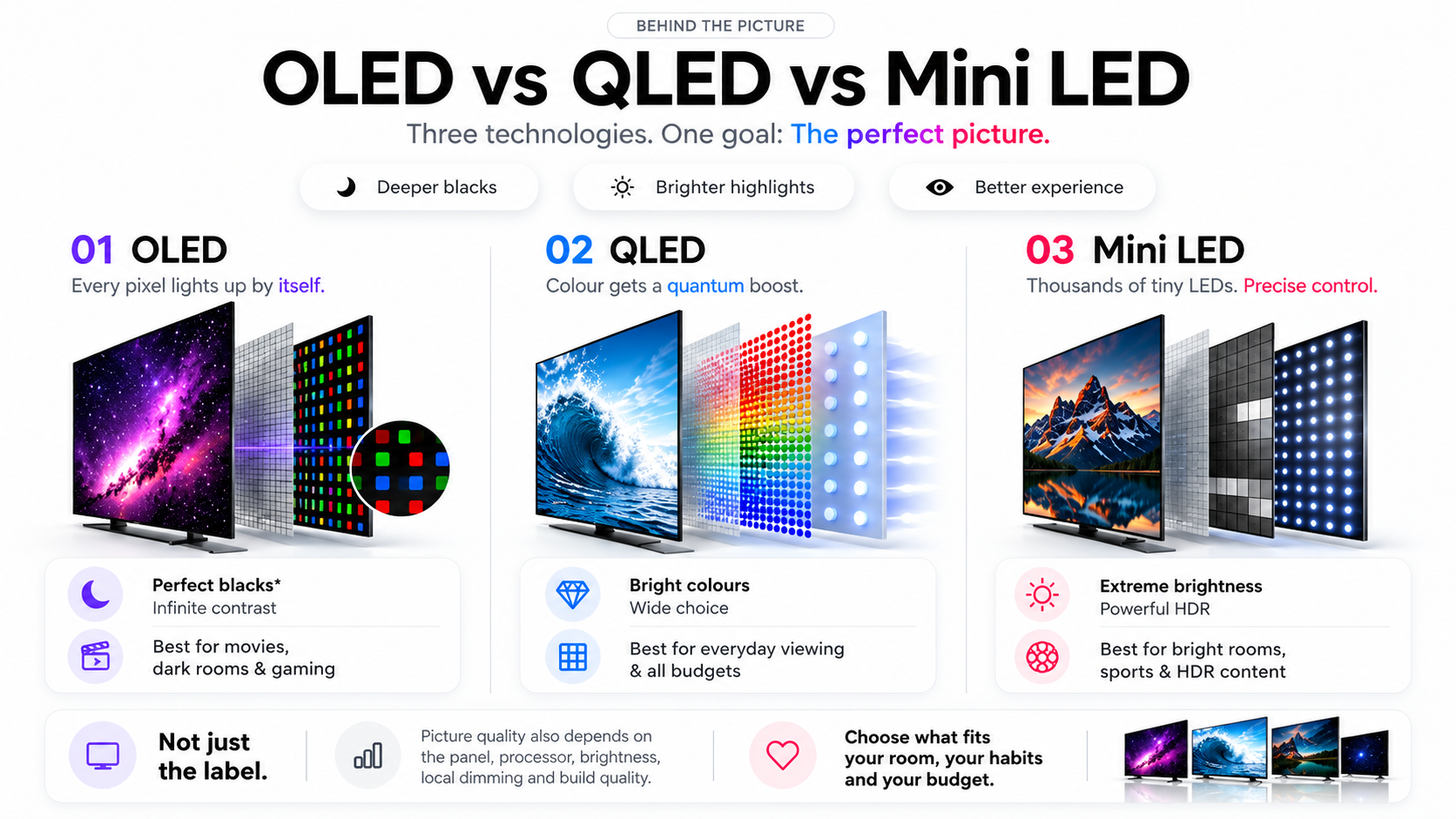
OLED stands for Organic Light-Emitting Diode. Unlike an LCD-based television, an OLED TV does not require a separate backlight. Every pixel produces its own light and can brighten, dim or switch off independently. Because an OLED pixel can turn off completely, it can display black without unwanted light from a backlight. This gives OLED TVs their signature deep blacks and strong contrast.
Main Advantages of OLED
OLED TVs are particularly strong in the following areas:
- Deep black levels
- High perceived contrast
- Wide viewing angles
- Fast pixel response
- Strong dark-room movie performance
Potential Limitations of OLED
Some OLED models cannot maintain the same full-screen brightness as the brightest Mini LED televisions. OLED panels also require sensible care when repeatedly displaying static elements such as news banners, channel logos, game maps or computer interfaces for long periods. Modern OLED TVs include panel-protection features such as pixel shifting, logo brightness adjustment and automatic panel maintenance. These features reduce the risk of permanent image retention, but they do not make it impossible.
If deep blacks, cinematic contrast and responsive gaming are your priorities, you can explore OLED TVs available at senQ and compare the exact specifications that suit your room and viewing habits.
What Is QLED and How Is It Different from OLED?
QLED stands for Quantum Dot Light-Emitting Diode. Most QLED televisions are LCD-based TVs that use an LED backlight together with a quantum-dot layer to improve colour reproduction and brightness.
Main Advantages of QLED
QLED TVs commonly offer:
- Strong colour performance
- Good bright-room visibility
- A wide selection of screen sizes
- Options across multiple budgets
- No OLED-style burn-in
- Broad brand availability
Picture quality depends heavily on the backlight design. A basic edge-lit QLED may have limited control over dark scenes, while a premium model with full-array local dimming can produce much better contrast.
Potential Limitations of QLED
Because QLED TVs rely on a backlight, they cannot control light at the individual-pixel level like OLED. Depending on the model, users may notice blooming around subtitles, greyer blacks in dark rooms, reduced contrast from the side or uneven brightness during sports. For Malaysian buyers, QLED usually provides the widest selection of brands, sizes and price points among these three technologies. You can explore QLED TVs available at senQ to compare options across different budgets and screen sizes.
Is Mini LED Better Than QLED?
Mini LED is not directly the opposite of QLED. Many Mini LED TVs are also QLED TVs because they combine a quantum-dot layer with a Mini LED backlight. Mini LED is an advanced backlight technology used in LCD televisions. Instead of using a smaller number of conventional LEDs, a Mini LED TV uses much smaller LEDs. This allows manufacturers to fit more lights and dimming zones behind the display, giving the TV more precise control over bright and dark areas.
Main Advantages of Mini LED
Mini LED TVs commonly offer:
- Strong peak and full-screen brightness
- Improved local dimming
- Better black levels than many conventional LED TVs
- Powerful HDR performance
- Strong visibility in bright rooms
- No OLED-style burn-in
Potential Limitations of Mini LED
Mini LED is still a backlit LCD technology. Even with many dimming zones, one zone may control multiple pixels, so a bright object against a dark background can create visible glow or blooming. The severity depends on the number and size of dimming zones, the local-dimming algorithm, processing, viewing angle and content. For viewers who prioritise brightness, HDR and daytime viewing, you can explore Mini LED TVs available at senQ and compare the specifications of individual models.
OLED vs QLED vs Mini LED Picture Quality Comparison
Black Levels and Contrast
Winner: OLED
OLED generally produces the strongest black levels because each pixel can turn off independently. It can show a bright object beside a completely dark area without relying on a backlight zone. Mini LED comes closer to OLED than many conventional LCD TVs, but some blooming may remain around subtitles and small highlights. QLED black levels vary. Premium models with effective local dimming can perform well, while basic models may produce greyer blacks.
Brightness and HDR
Winner: Mini LED, depending on the model
Mini LED TVs are often designed to achieve powerful peak brightness and maintain brightness across larger areas of the screen. This helps HDR movies, sports and games remain impactful in a bright room. Premium QLED TVs can also offer strong brightness. Newer OLED models produce impressive highlights, but buyers should compare the exact TV instead of assuming every Mini LED is brighter than every OLED.
TV Colour Performance
Winner: Model-dependent
QLED and Mini LED TVs that use quantum dots can maintain vivid colours at high brightness levels. OLED also delivers excellent colour, while QD-OLED combines self-emissive pixels with quantum dots for stronger colour brightness.
Viewing Angles
Winner: OLED
OLED usually maintains contrast and colour more consistently when viewed from the side. Viewing angles on QLED and Mini LED depend on the LCD panel and any enhancement technology used by the manufacturer. This matters in wide living rooms where viewers sit away from the centre.
Motion and Screen Uniformity
Winner for pixel response: OLED
Screen-uniformity winner: Model-dependent
OLED’s fast pixel response can help action movies, football, badminton, motorsports and games appear clearer. QLED and Mini LED can also provide smooth motion, but performance depends on response time, refresh rate and processing. Screen uniformity refers to how evenly a TV displays one colour. Poor uniformity may appear as dark patches, vertical bands or a dirty-screen effect during camera movement. This is particularly noticeable during sports.
OLED Burn-In and TV Lifespan
Burn-in is permanent image retention caused by uneven pixel wear. It can occur when the same static elements are displayed repeatedly for extended periods, including news banners, channel logos, game maps and desktop interfaces. Modern OLED TVs use pixel shifting, logo detection and panel-cleaning features. Keep these protections enabled. Mini LED and QLED do not experience OLED-style burn-in, but they are not immune to ageing. Backlights can lose brightness, while LCD panels may develop uniformity issues or hardware faults.
WOLED vs QD-OLED: Are All OLED TVs the Same?
No. Different OLED panel designs can produce different results.
What Is WOLED?
WOLED traditionally uses white OLED light together with colour filters. It is known for deep blacks, strong viewing angles and excellent overall picture quality.
What Is QD-OLED?
QD-OLED combines an OLED light source with quantum-dot colour conversion. It can produce vivid colours and strong colour brightness, especially in HDR highlights.
OLED vs QLED vs Mini LED in Malaysia
For Malaysian households, the following factors can help narrow the choice.
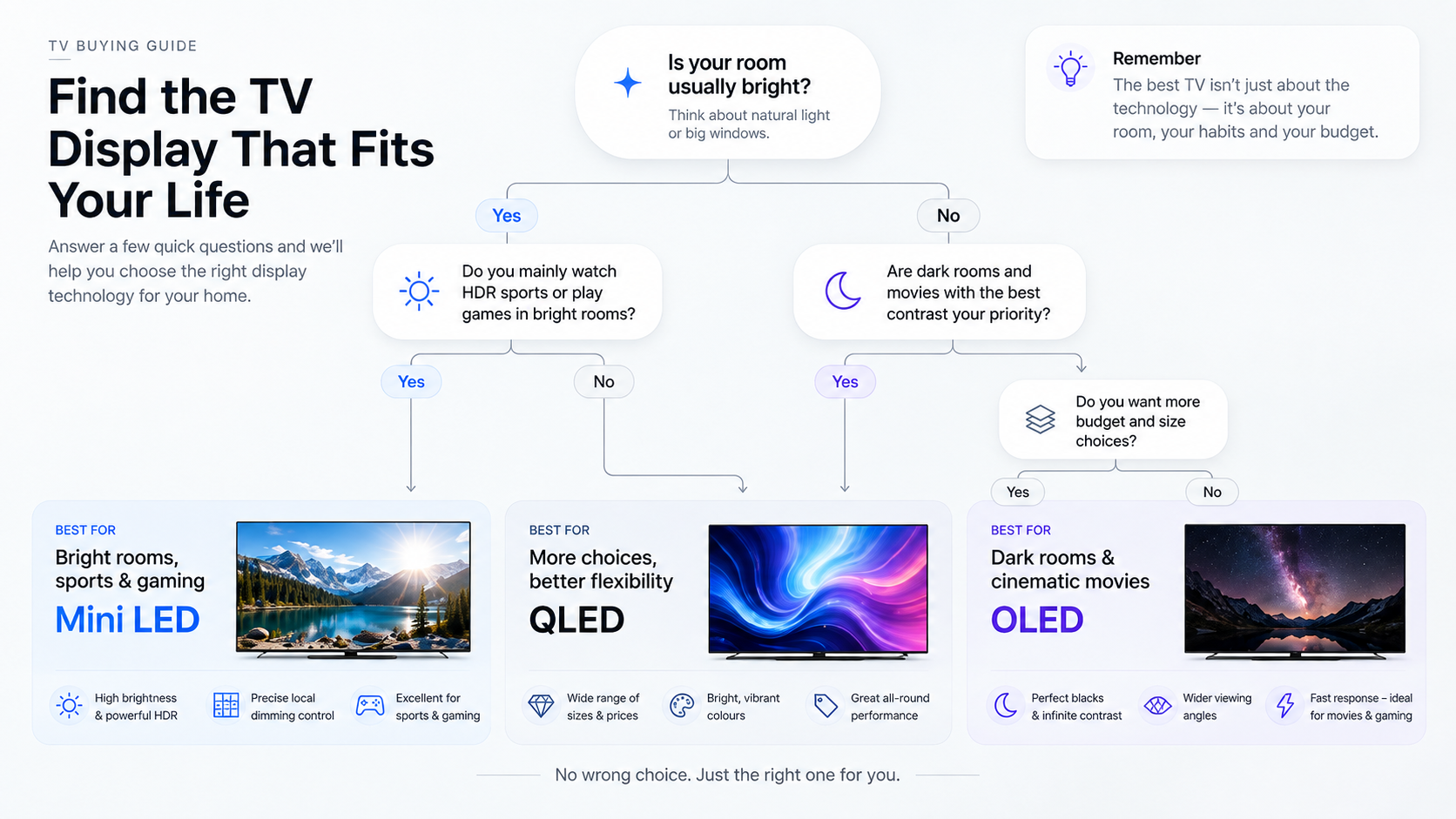
Room Lighting
A home with large windows or strong afternoon sunlight may benefit from Mini LED or a bright QLED TV.
OLED may be a better fit for a darker room or users who mainly watch at night.
Screen Size and Budget
QLED usually offers the broadest range of sizes and prices.
OLED is commonly positioned in the premium segment, while Mini LED options increasingly cover mid-premium and flagship levels.
Check whether the same series uses identical specifications across every size. Some manufacturers may use different panels or features within one range.
Warranty and After-Sales Support
Before choosing a TV, compare more than just the panel technology or selling price. Also check:
- Product and panel warranty
- Extended warranty options
- Installation services
- Delivery conditions
- Replacement policies
- Service-centre availability
When comparing TVs at Senheng or senQ, check the exact product page or speak with the team about the warranty, delivery, installation and after-sales options available for the model you are considering. These details can matter just as much as the display technology when buying a television you expect to use for several years.
Final Verdict
There is no single winner between OLED, QLED and Mini LED for every home. OLED remains the strongest choice for buyers who prioritise deep blacks, movies, gaming response and wide viewing angles. Mini LED makes more sense when brightness, daytime viewing, sports and impactful HDR are more important. QLED offers the most flexibility, with a wider selection of screen sizes, brands and price points for Malaysian households.
The display technology should therefore be the starting point rather than the final decision. Compare the exact model, panel quality, refresh rate, picture processing, gaming features, room lighting and price before buying. A good QLED can be a better choice than a weak Mini LED, while a modern OLED may work perfectly well in a living room that receives plenty of light. The best TV is ultimately the one that suits how, where and what you actually watch.
Frequently Asked Questions
- Can most people actually see the difference between OLED, QLED and Mini LED?
Yes, but the difference is usually easier to notice in certain situations. OLED’s deeper blacks are most visible during movies watched in a dark room, while Mini LED’s higher brightness is more noticeable in a bright living room or when watching HDR content.
For regular television programmes, YouTube or casual streaming, the quality of the individual TV model, picture processor and settings may matter more than the display technology alone.
- Should I be worried about OLED burn-in?
Burn-in is possible, but the level of risk depends heavily on how the TV is used. It is more relevant when the same static image, such as a news banner, game interface or desktop taskbar, remains on screen for many hours every day. For households that watch a mixture of movies, streaming programmes, sports and games, burn-in is generally less likely to become a practical problem. Keep the TV’s built-in panel-care features enabled and avoid switching off the power immediately when the TV is performing automatic panel maintenance.
- How important is the brand compared with the display technology?
The exact model is more important than the display label or brand name by itself. Different TVs from the same brand may use different panels, backlights, processors and gaming features.
- Which TV Technology Offers the Best Value for Malaysian Households?
For Malaysian buyers prioritising screen size, brightness and price flexibility, QLED will often provide the best overall value. OLED remains the stronger premium choice for movies and gaming, while Mini LED is worth considering for bright rooms and impactful HDR.